· Science · 2 min read
Learned immunity in ants!
I am fascinated by ants, so when I find something cool I'll post it, especially when it involves immunology!
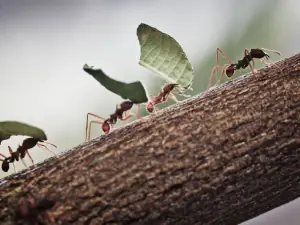
I’m a big fan of ants, obviously not in my house or during a picnic, but as a species they fascinate me. At the moment I’m reading the book Empire of Ants and infections, zombies and parasites are discussed. This is all very tragic for the ant, but luckily they have an immune system! Wait what?! I never thought about this before and apparently they are even more resistant to a second infection after going through a first! This implies some form of adaptive immunity, fascinating! The book has a whole thing about social immunity which is very interesting, but what struck me the most is that individual ants can have some form of trained immunity. Ants can even spread their ‘immunity’ to other individuals while exchanging food! (through antimicrobial peptides)
Since ants lack T and B cells, immunological memory in the vertebrate sense is out of the question. However, being able to better withstand a second infection is also seen in innate immunity. Ants do have immune cells, hemocytes, as well as specialized metapleural glands that secrete anti-microbial peptides, so there is machinery for an innate response to work with.  Somehow this can be tuned against certain pathogens? Does this mean that an ant that is ‘activated’ remains that way? Is this a disadvantage for other aspects of ant life?
I was unable to find a lot of information about immunology in ants, but the few observations that have been made are fascinating and really argue in favor of trained innate immunity, ‘innate memory’. I wonder if this is conserved and somehow connected to innate lymphoid cells as described by Itziar Martinez Gonzalez.